

















Hire QA Software Tester

Every release should deliver stable, reliable user experiences.

QA testing icon

Ensure reliable software delivery through structured QA, automation, performance validation, and defect prevention at every stage.

verified

ISTQB-Certified QA Engineers

verified

Onboarding in 48-72 Hours

verified

Full IP Ownership & Secure Processes

verified

ISTQB-Certified QA Engineers

verified

Onboarding in 48-72 Hours

verified

Full IP Ownership & Secure Processes

QA
Ship Reliable Software With Confidence.

ISTQB-Certified Engineers

ISTQB-Certified Engineers

Automated & Manual Testing

Automated & Manual Testing

Full Test Coverage

Full Test Coverage

Start within

48

hours

Deliver reliable, stable, and user-ready software with dedicated QA engineers who ensure every release meets real-world expectations. Our QA testers validate your product across real user workflows, edge conditions, and performance scenarios — supporting consistent quality across every release cycle.

AI chip

AI-assisted testing workflows reduce repetitive validation effort, allowing faster release cycles and more efficient QA coverage.

Why Teams Trust NebulaTech
for QA Hiring

The difference between a QA tester and a strong QA partner lies in understanding how your product behaves across real release conditions.

Consulting-Led Approach

Consulting-Led Approach

NebulaTech operates as a consulting-led delivery partner. Before we shortlist a QA engineer, we take the time to understand your product environment: your release cadence, your risk tolerance, the critical paths users depend on, and the type of coverage that aligns with your release process and product requirements. Staffing isn't the starting point — quality strategy is.

Industry Experience

Industry Experience

Our QA specialists have worked across fintech, healthcare, SaaS, and e-commerce — industries where quality standards directly affect business and compliance expectations. They bring more than test execution; they bring product awareness and a structured approach to quality assurance that keeps your releases predictable.

Quality Assurance, Not Just Test Execution

Quality Assurance, Not Just Test Execution

For teams building cross-platform products or evaluating as part of a broader delivery improvement initiative, our software testing services provide structured QA coverage that scales with your release cycle. Businesses managing complex system environments can also explore how our legacy application maintenance approach handles quality across evolving codebases.

Timezone-Aligned Collaboration

Timezone-Aligned Collaboration

Work seamlessly across US, UK, EU, and APAC time zones with structured overlap and real-time communication.

Multilingual & Communication-Trained Engineers

Multilingual & Communication-Trained Engineers

Our QA engineers are trained in clear documentation, stakeholder communication, and cross-team collaboration for smooth project execution.

Rocket

The next step is understanding where structured QA processes create the most measurable impact.

QA Services You Can Hire For

Choose QA services based on your product needs, release cycle, and testing scope.

Manual Testing

Structured human-led testing across functional scenarios, edge cases, and user workflows.

Automation Testing

Script-based test execution for regression cycles, CI/CD pipelines, and repetitive validation scenarios.

Performance Testing

Load, stress, and scalability testing to validate product behaviour under real-world traffic conditions.

API Testing

Validation of API endpoints, data integrity, response accuracy, and integration reliability.

QA Consulting

Strategic review of your testing process, coverage structure, and quality assurance approach before scaling.

Mobile Application Testing

Cross-device and cross-OS testing for iOS and Android applications across real and simulated environments.

Free QA Process Review

Get a quick evaluation of your current testing workflow, release cycle, and quality gaps from our QA experts.

Why Hire QA Software Testers — And When It's the Right Call

Dedicated QA testers aren't the right answer for every team at every stage. They're the right answer when software quality requires dedicated operational focus that your development team doesn't have the bandwidth or specialization to manage on its own.

The scenarios where QA tester hiring makes strategic sense:

Faster Releases Need Stronger QA

Faster Releases Need Stronger QA

Your release cadence is accelerating and regression testing is requiring more structured coverage that delays deployment.

Maintaining Quality at Scale

Maintaining Quality at Scale

Release quality consistency is becoming harder to maintain at a frequency that's starting to affect user trust or business metrics.

Complex Systems Require Broader Test Coverage

Complex Systems Require Broader Test Coverage

You're building for multiple platforms or complex integration environments where manual coverage is insufficient.

Independent Validation Matters

Independent Validation Matters

Your development team is testing their own code — which is efficient in the short term but limits independent validation coverage over time.

Critical Releases Demand Dedicated QA

Critical Releases Demand Dedicated QA

A product launch, compliance audit, or major feature release requires structured quality coverage that your current process can't provide.

Signs it's time to hire rather than build internally:

Dedicated QA Ownership

Dedicated QA Ownership

QA is being handled informally by developers between tasks — not as a dedicated function.

Specialized Testing Expertise

Specialized Testing Expertise

You need specific skills, such as automation engineering or performance testing, that don't exist in the current team.

Flexible QA Capacity

Flexible QA Capacity

You require QA capacity for a defined period without committing to permanent headcount.

Rocket

Once hiring becomes the right approach, the next question is what you actually gain from the right team.

Where Software
Quality Processes Require Stronger Structure

Improving QA outcomes starts with understanding how coverage aligns with release requirements and user workflows.

Ensure consistent test coverage across all release cycles

Structured QA ensures edge cases are identified early and handled before release — so coverage is built around where risk actually lives, not just the obvious paths.

Regression cycle efficiency and automation coverage

Without structured automation coverage, every release requires full manual retesting. This slows delivery and creates pressure to cut test coverage to meet deadlines.

Structured onboarding and product-context alignment

Offshore QA testers placed without structured onboarding often lack the product context to test what actually matters. Execution remains process-driven rather than product-context-driven.

Consistent coverage across release cycles

When QA is treated as a post-development step rather than an integrated part of delivery, coverage is uneven. Some areas are tested repeatedly; others are barely touched.

Flexible QA capacity without fixed internal overhead

Recruiting, onboarding, and retaining in-house QA engineers carries overhead that offshore dedicated testers eliminate, without reducing the quality of coverage.

Handled early, these areas remain predictable with a structured QA approach integrated early in the development cycle. Structured QA delivers measurable value from the first release — reducing rework, improving coverage, and keeping release timelines predictable.

Rocket

This is where hiring the right QA engineers with a structured approach makes a measurable difference.

Quick Overview — What You Get When You Hire QA Software Testers

Developer working at a professional office setup

Shortlisted QA engineers within 24-48 hours — pre-vetted and matched to your release process.

Manual and automation testing aligned to real risk areas — aligned with real release priorities.

Structured QA evaluation before onboarding — quality strategy first, execution second

Flexible engagement — scale QA capacity without renegotiation.

Full IP ownership and NDA protection — standard on every engagement.

AI-assisted testing workflows — faster regression cycles and reduced manual effort.

Many of our QA engineers hold ISTQB certifications, ensuring adherence to globally recognised testing standards and best practices.

What You Get When You Hire QA Engineers from NebulaTech

The difference between a functional QA tester and a strong one usually lives in two places: test strategy and risk judgment. Our QA engineers bring both.

QA Quality

  • Our QA specialists are vetted for testing methodology, not just tool familiarity. They understand how to build coverage that reflects how real users interact with software — not just how developers expect them to.

  • This allows QA engineers to focus more on identifying defect patterns before they become systemic, not just logging issues as they surface.

  • AI-assisted workflows support this process by reducing time spent on repetitive testing tasks — such as generating baseline test cases, identifying recurring defect patterns, and accelerating regression cycles.

  • This allows QA engineers to focus more on edge cases, usability issues, and failure scenarios that require human judgment, rather than spending time on predictable validation work.

Assessment & Test Strategy

  • Every engagement begins with a review of your current testing approach, product risk areas, and release process.

  • Test planning covers coverage priorities, test environment requirements, and the integration points most likely to generate defects under load or edge conditions.

Scalability by Coverage

  • Testing frameworks and test suites are structured to grow with your product.

  • As features are added and the application scales, test coverage expands incrementally rather than being rebuilt from scratch with every major release.

How We Use AI in Quality Assurance and Testing

We use AI in practical ways focused on improving QA efficiency and delivery consistency.

AI in QA

AI in Quality Assurance

Our QA engineers use AI-enabled testing techniques to accelerate test case generation, identify risk-prone areas, and optimise regression cycles. AI-assisted validation helps detect anomalies, improve test coverage, and reduce manual effort in repetitive testing scenarios.

AI + Product Quality

AI in Test Optimisation & Product Quality

AI-driven insights help prioritise validation scenarios requiring deeper coverage, analyse defect patterns across releases, and improve decision-making in QA cycles. This enables sharper test focus, faster release validation, and stronger coverage where it matters most.

How you engage the team is just as important as who you hire.

Pre-Launch QA Sprint

Ensure your product is fully validated before release with a focused QA sprint covering performance, usability, and stability.

Hiring Models — Choose What Fits Your QA Stage

Different teams have different QA needs. A startup preparing a first release has a different structure than an enterprise managing continuous delivery across multiple product lines. We offer flexible hiring models aligned to your QA requirements.

Full-Time Hiring

A dedicated QA engineer works as an extension of your team, building deep familiarity with your product architecture and delivering consistent test coverage across every release cycle.

Best For: Ongoing QA coverage, continuous release cycles, and evolving product environments.

Part-Time Hiring

Ideal when releases require validation, regression coverage, or feature testing, but the volume does not justify a full-time engagement.

Best For: Teams that need structured QA support without full-time capacity.

Fixed Monthly Support

Covers regression cycles, test maintenance, coverage updates, and minor enhancements under a fixed monthly scope — without renegotiation on every release.

Best For: Organisations needing predictable QA coverage and ongoing optimisation.

Once the hiring model is clear, the next concern is how teams actually collaborate and communicate day-to-day.

Team Structure and Communication — How We Keep Quality on Track

One of the most common concerns with offshore QA testers is how quickly they can align with product workflows and release expectations — and whether there is enough visibility into your release process to flag issues at the right time. We address this through structure.

How the delivery team is organised:

QA Engineer(s)

accountable for test coverage, defect quality, and test execution consistency.

QA Lead (on larger engagements)

owns test strategy, coverage prioritisation, and process improvement.

Project Manager

coordinates testing schedules, manages scope, and keeps communication with the client structured.

Client

retains full visibility and direct access at all times.

Communication tools and rhythm:

Daily Standups

  • Via your preferred platform — Slack, Teams, or equivalent
  • Timezone overlap engineered into engagement planning
  • UK, US, and European business hour coverage supported

Weekly Reports

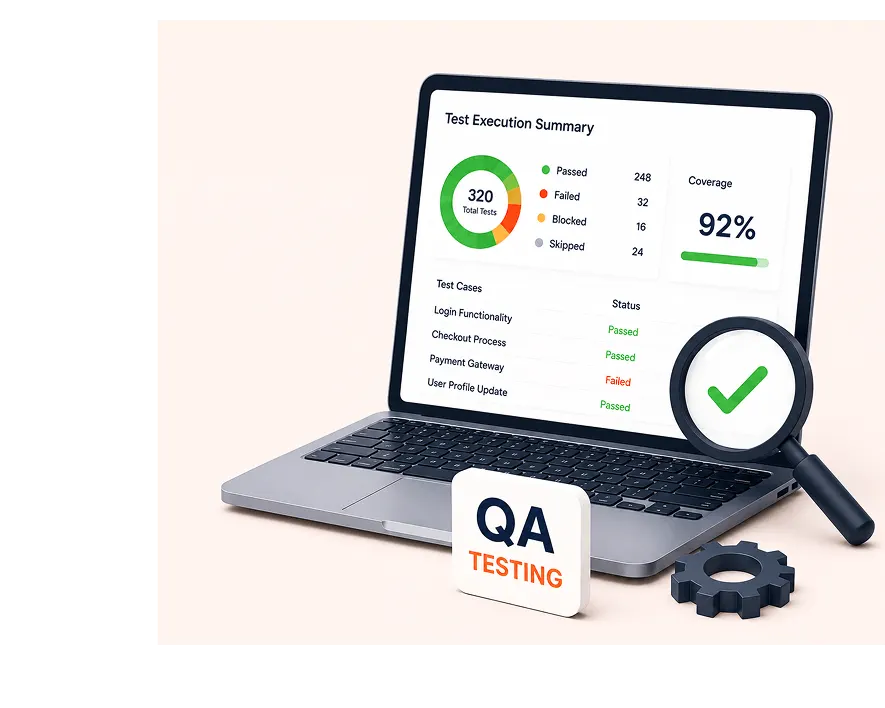
  • Weekly test summary reports covering coverage metrics, defect rates, and blocked items
  • Architecture-level decisions and defect triage logic maintained in structured documentation

Test Management Tools

  • Collaborative test management via TestRail, Jira, or your existing tooling

Documentation

  • Coverage rationale and defect triage logic maintained as part of structured project documentation
  • When the product grows or the team changes, that documentation travels with it

Beyond communication, technical capability plays a key role in long-term success.

QA Engineer Expertise and Technical Capabilities

Modern QA engineering requires more than test execution. It requires fluency across the full testing spectrum — functional, non-functional, automation, and integration — combined with the product judgment to know which coverage matters most.

Manual and Functional Testing

  • Functional testing across web, mobile, and API layers
  • Exploratory testing — structured but judgment-led, targeting scenarios that require contextual human validation
  • Regression testing and release readiness reviews
  • Usability and UX validation aligned with real user workflows

Automation Engineering

  • Selenium, Playwright, Cypress — browser-level automation for web applications
  • Appium for mobile test automation across iOS and Android
  • API testing via Postman, RestAssured, or equivalent tooling
  • Framework design: Page Object Model, data-driven, and behaviour-driven (BDD/Cucumber)

Performance and Non-Functional Testing

  • Load and stress testing via JMeter, k6, or Locust
  • Response time benchmarking and performance constraint identification under simulated traffic
  • Security and compliance testing for HIPAA, PCI-DSS, and GDPR-adjacent requirements

CI/CD Integration and AI-Assisted Testing

  • Test pipeline integration via Jenkins, GitHub Actions, CircleCI
  • AI-assisted test generation reducing the time spent writing boilerplate test cases and shifting focus toward coverage analysis and edge case identification
  • Defect tracking and reporting via Jira, Bugzilla, or your existing system

With the right expertise in place, the next step is understanding how quickly you can get started.

Manual TestingManual Testing
SeleniumSelenium
AppiumAppium
PlaywrightPlaywright
PostmanPostman
JMeterJMeter
Rest AssuredRest Assured
SQLSQL
JenkinsJenkins

With the right expertise in place, the next step is understanding how quickly you can get started.

QA Ecosystem & Technology Stack

Our QA engineers work across the full testing ecosystem — from core validation and automation to integrations, scalability, and performance optimisation.

Core Testing Tools

SeleniumCypressPlaywrightAppium

Test Management & CI/CD

JIRATestRailJenkinsGitHub Actions

API & Integration Testing

PostmanREST Assured

Performance Testing

JMeterLoadRunner

Advanced Capabilities

AI-enabled testingTest automation frameworksContinuous testing pipelines

Our Hiring Process — From Brief to Active Testing

Start with qualified QA testers in as little as 48 hours. We've structured the process to streamline onboarding and QA team alignment: eliminating vague briefs, mismatched shortlists, and onboarding that takes weeks before the first test is written.

01

QA Tester Shortlisting

We identify and shortlist the best QA engineers for your needs.

24-48 hours

02

Technical Interview

You interview shortlisted candidates (technical + cultural fit).

1-2 days

03

Onboarding & NDA Signing

NDA signing and onboarding are handled in parallel, not sequentially.

2-3 days

04

Active Testing Start

Testing begins immediately upon onboarding completion.

Immediate upon Onboarding

How the process works in practice:

You submit your requirements — product type, testing scope, existing tooling, and release cadence.

We shortlist QA engineers from our vetted pool, matched against your stack and coverage priorities.

You interview shortlisted candidates — technical capability and working style both matter.

NDA signing and environment onboarding run in parallel, not sequentially.

Testing begins immediately upon onboarding completion.

No padding. No multi-week recruitment cycles before a tester sees your product. The process is fast because it's designed to be.

This structured process ensures both speed and clarity in onboarding.

Understanding QA Tester Cost — What Actually Affects Your Investment

We don't publish rate cards, and for good reason. The cost of hiring a software tester depends on factors that generic pricing ignores. What matters is the total value delivered relative to the quality consistency it supports.

Experience Level

Junior, mid-level, senior, and lead QA engineers have different rate bands that reflect the complexity of testing they can handle independently. A senior automation engineer costs more per day and typically delivers better long-term test coverage, because the frameworks they build reduce recurring manual effort across every subsequent release.

Engagement Model

Dedicated QA testers provide cost predictability over time. Project-based models offer clearer upfront budgeting for defined testing initiatives. The right model depends on whether your QA needs are continuous or milestone-driven.

Testing Scope and Technical Requirements

Applications with complex integrations, real-time features, or multi-platform requirements need broader coverage and more senior QA capacity.

Compliance requirements (HIPAA, PCI-DSS) add documentation, reporting, and validation layers that affect total investment.

Automation testing carries higher upfront effort but significantly reduces the cost per release cycle over time.

Timeline

Compressed timelines require more parallel testing capacity. If a launch date is fixed, the team composition — and cost — scales to meet that constraint.

How to Think About Value, Not Just Cost

Hiring offshore QA engineers reduces cost significantly compared to equivalent in-house hires in the US or UK — without reducing coverage quality when hiring is structured correctly.

  • Structured QA significantly reduces the operational impact of post-release fixes of defects found in production — the QA investment pays for itself quickly when measured against the true cost of post-release fixes.
  • AI-assisted testing workflows improve efficiency on repetitive validation tasks — regression testing, repeated scenarios, and bug pattern detection become faster without increasing team size.
  • Structured QA from the start supports sustainable test coverage as the product evolves that becomes expensive to cover later.

Cost is only one part of the decision. Comparing different hiring approaches provides better clarity.

Comparing Your Hiring Options - Freelancer, Agency, and Dedicated

Understanding what each approach actually delivers helps you choose the model that fits your product risk tolerance, delivery timeline, and budget structure.

For most teams managing active release cycles, the dedicated QA model offers the best balance of consistent coverage, communication clarity, and long-term cost efficiency.

Freelancer vs Agency vs Dedicated QA Team vs In-House

Criteria

  • Cost Predictability
  • Team Continuity
  • Communication
  • Scalability
  • Code Ownership
  • Risk Level

Freelancer

  • Low
  • Risk of churn
  • Direct but limited
  • Add freelancers ad hoc
  • Negotiable
  • Higher

Agency

  • Medium
  • Resource Rotation
  • Account manager layer
  • Agency Capacity Limits
  • Varies
  • Medium

Dedicated Team

  • High-fixed monthly
  • Consistent team
  • Direct daily access
  • Scale up/down easily
  • 100% client-owned
  • Lower

In-House

  • High — but overhead-heavy
  • Stable if retained
  • Internal
  • Headcount approvals
  • Standard employment law
  • Medium

Swipe to compare

Offshore Dedicated vs In-House QA Hiring

In-House

  • Hiring Time
    6-12 weeks
  • Cost Structure
    Salary + benefits + overhead
  • Talent Pool
    Limited to local market
  • Flexibility
    Fixed team size
  • Knowledge Retention
    High (If staff stays)
  • IP Protections
    Standard employment law
VS comparison marker

Offshore Dedicated

  • Hiring Time
    24-48 hours
  • Cost Structure
    Engagement-based, no overhead
  • Talent Pool
    Access to global specialists
  • Flexibility
    Scale as needed
  • Knowledge Retention
    High dedicated assignment
  • IP Protections
    NDA + full IP ownership

Hiring Speed Comparison

In-House

Job Post
6-12 Weeks
Start

Offshore Dedicated

Brief
24-48 hours
Active Testing

The dedicated offshore model consistently outperforms alternatives on speed of onboarding, flexibility of coverage, and total cost — particularly when the goal is sustained quality assurance across multiple release cycles.

Understanding these differences helps in making a more informed hiring decision.

Who Hires QA Software Testers — And Why

Quality assurance requirements vary significantly by organisation type and product context. Here's how different teams typically approach QA hiring.

Startups

Speed is the primary driver, but defects are expensive. Startups hire QA testers to maintain release velocity without accumulating a defect backlog that slows down future development. Flexible QA engagement allows quality coverage to scale with product growth — without committing to permanent headcount before the product has validated demand.

Mid-Market and Enterprise Organizations

Teams that have a validated product and an accelerating release schedule often reach a point where their existing QA process can't keep pace. Bringing in dedicated software testers allows the development team to focus on feature delivery while QA specialists handle coverage, regression, and release readiness independently.

Enterprises

EEnterprise teams typically hire QA engineers for one of three reasons: modernizing legacy application testing, building automation coverage for continuous delivery pipelines, or meeting compliance testing requirements that general-purpose developers aren't equipped to handle. The consulting-led engagement model is especially relevant here, as large organizations benefit from a QA strategy review before additional testing resources are brought in.

Digital Agencies

Agencies bring in QA testers on a project basis to expand delivery capability for clients without maintaining a permanent QA practice. Dedicated software testers for hire allow agencies to take on quality-critical projects without the overhead of in-house QA infrastructure.

These scenarios reflect how different teams benefit from structured QA hiring.

What Structured
QA Hiring Delivers

The outcomes that matter don't appear on a CV. They emerge from how an engagement is structured and how quality decisions are made throughout the development cycle.

01

Faster Onboarding, Fewer False Starts

Teams that hire through NebulaTech's structured process typically move from brief to active testing in under a week.

Pre-vetted QA engineers combined with parallel onboarding — environment access and NDA handled simultaneously — eliminate the lag that typically costs two to three weeks before the first test is executed productively.

02

Reduced Rework from Preventable Defects

When QA is integrated early rather than bolted on after development, issues are caught before they compound.

Products that go through structured QA planning — with test coverage defined at the requirements stage — see significantly fewer emergency fixes in the weeks following release.

03

Release Confidence at Scale

Automated regression suites and structured manual coverage mean that as the product grows, each new release doesn't require starting QA from scratch.

Coverage built on a solid framework scales with the product — maintaining confidence across releases, not just during the initial launch period.

Why NebulaTech
— What Makes the Difference

There's no shortage of qa engineers for hire. The question is what surrounds them: the evaluation process, the testing strategy, and the risk controls that determine whether the engagement actually improves your software quality.

Consulting-first approach to QA testing

Consulting-First Approach

We don't start with staffing. We start by understanding your product, your release process, and where quality risk actually lives. That means evaluating whether manual testing, automation, or a hybrid approach is right for your current stage — before we shortlist a single QA engineer.

Risk reduction by design

Risk Reduction by Design

NDA protection is standard, not negotiated. Full IP ownership belongs to the client without ambiguity. Our QA specialists work under clear contracts that specify deliverables, coverage scope, and how changes to testing priorities are handled. No surprises.

Practical AI usage in QA testing

Practical AI Usage

Where AI tooling genuinely improves throughput — test case generation, pattern-based defect identification, regression prioritization — we integrate it into the QA process without overstating its role. The goal is faster cycles, not the appearance of innovation.

What Makes Us Different

No rigid lock-in — engagement models flex with your release schedule and product stage.

Easy scaling — add QA engineers before a major launch and reduce capacity between intensive cycles.

Direct team access — no account manager gatekeeping communication with your own QA engineers.

Transparent coverage — test plans, defect logs, and coverage metrics are visible and documented.

Software quality assurance services built for long-term product health, with long-term release consistency in mind.

Explore Related Resources

For broader context on software development quality and hiring options, these pages provide additional information:

Frequently Asked Questions

You can typically have a shortlisted QA engineer ready to interview within 24–48 hours. Onboarding — including NDA signing and environment access — completes within 2–3 days, and testing begins immediately after. This speed is possible because we maintain a vetted pool of QA specialists rather than recruiting from scratch against every brief.

Hire QA Software Testers — Start Within 48 Hours

Structured QA supports reliable performance across every release cycle, with consistent validation, scalable coverage, and predictable quality outcomes.

Whether you need a dedicated QA engineer, a full testing team, or strategic QA support — NebulaTech aligns the right expertise to your product and delivery process.