React Native App Development Cost in the USA: 2026 Guide
Discover React Native app development costs in the USA, including hourly rates, project estimates, key cost factors, timelines, and hiring options.

Bharat Purohit
Mobile App & Technology Consultant

In this Article
In this Article
- React Native App Development Cost in the USA at a Glance
- 2Key Factors Affecting the React Native App Development Cost
- 3How to Reduce React Native App Development Cost
- 4React Native App Development Cost by App Type
- 5Hidden Costs to Budget for Beyond Development
- 6How Long Does It Take to Build a React Native App?
- 7How Does Team Structure and Location Impact React Native Development Costs?
- 8Connect With React Native Developers at NebulaTech
- 9FAQs on React Native App Development Cost
Let's Build the Right Solution, Not Just Software.

Summarize with AI
Short on time? Get the key points instantly with AI.
 ChatGPT
 Perplexity
React Native App Development Cost in the USA: 2026 Guide
Planning a React Native app is exciting, but one question often comes first: how much will it cost? In the USA, React Native app development typically costs $15,000 to $350,000+, depending on complexity, with enterprise-grade builds at the top of that range.
The React Native app development cost depends on factors such as app complexity, features, design, integrations, and the development team you choose. A simple app may cost around $15,000–$40,000, while medium-complexity apps often range from $40,000–$100,000.
In this guide, we'll explore the key factors that influence React Native app development costs and help you understand what you can expect to spend on your project.
React Native App Development Cost in the USA: At a Glance
A React Native app can cost approximately $15,000–$350,000+ in the USA, depending on its complexity, features, design, backend, integrations, security requirements, team structure, and development model. A focused MVP may fall toward the lower end, while complex SaaS, fintech, healthcare, marketplace, and enterprise applications can require significantly larger budgets.
To understand how the budget changes with the app's scope, refer to the table below. It provides a practical breakdown of the cost to build a React Native app, estimated development time, typical inclusions, and the type of business each app is best suited for.
| Product Scope | Cost Range | Typical Timeline | What Usually Drives Cost | Best For |
|---|---|---|---|---|
| Basic App/MVP | $10,000–$30,000 | 2–4 Months | Basic UI, login, core features, simple database, limited integrations, basic testing | Startups, MVPs, internal tools, simple content apps |
| Medium-Complexity App | $30,000–$100,000 | 4–8 Months | Custom UI/UX, user authentication, payments, APIs, push notifications, analytics, admin panel | SaaS, e-commerce, marketplaces, growing businesses |
| Complex App | $100,000–$250,000+ | 6–12 Months | Real-time features, advanced backend, multiple integrations, complex user roles, offline functionality | On-demand apps, social platforms, logistics, feature-rich products |
| Enterprise App | $250,000–$350,000+ | 9–18+ Months | Advanced security, complex workflows, scalability, extensive integrations | Large businesses, fintech, healthcare, regulated industries |
These figures are estimates rather than fixed prices. Your actual cost may be higher or lower based on the features, design requirements, team location, and level of customization involved.
Key Factors Affecting the React Native App Development Cost
The table above gives you a useful starting point for budget estimation, but your final budget can vary significantly from one app to another. Two React Native applications can use the same framework and still have dramatically different development budgets.
In our experience, the framework is only one part of the equation. The biggest differences usually come from product complexity, backend architecture, integrations, platform-specific requirements, security, and the level of engineering and testing required.
Here are the key factors that can influence your React Native development cost:
App Complexity, Features, and Functionality
Your app's complexity directly affects development time and cost. A basic app with a few screens and simple functions will require fewer resources than a feature-rich platform.
Features such as user accounts, payments, real-time chat, GPS tracking, multiple user roles, offline functionality, and complex workflows can increase the development effort. The more functionality your app needs, the more time is required for development and testing.
UI/UX Design and Customization
Your app's design also plays a role in the overall cost. A simple interface using standard components is generally more affordable than a fully customized design with unique layouts, animations, and interactions.
The number of screens, user journeys, design revisions, and platform-specific requirements can also affect the budget. Investing in a clear and user-friendly design is important, but keeping the initial version focused can help control costs.
Backend, APIs, and Third-Party Integrations
React Native handles the application layer, but most production applications also require backend services for users, data, business logic, authentication, and integrations. A simple product may need a relatively lightweight backend, while a complex SaaS, marketplace, fintech, or real-time application may require custom APIs, databases, cloud infrastructure, background processing, and advanced security.
From our experience, backend and integration work is one of the areas most likely to be underestimated during early budgeting. A third-party service may appear simple from its API documentation, but production implementation can involve authentication, error handling, webhooks, retries, security, testing, monitoring, and platform-specific behavior.
This is why we recommend assessing integrations during discovery rather than treating them as small development tasks that can be added later.
Advanced Technologies and Security Requirements
Advanced technologies can increase both development time and the skills required to build your app. Features involving AI, IoT, AR/VR, real-time processing, or advanced location services may require additional development work and specialized expertise.
Security requirements can also affect the budget. Apps handling payments, personal information, or sensitive business data may need stronger authentication, encryption, access controls, and security testing. Apps in regulated industries may have additional compliance requirements.
Development Team and Hiring Model
Who you hire to build your app can significantly affect the final cost. A US-based development agency may charge more than an offshore or nearshore team because of differences in hourly rates and operating costs.
Your hiring model matters too. You can work with a development agency, hire freelancers, build an in-house team, or use a dedicated development team. The right option depends on your budget, project complexity, timeline, and level of involvement.
Testing, Deployment, and App Store Requirements
Development is not complete when the code is finished. Your app needs to be tested across different devices and operating system versions to identify bugs and performance issues before launch.
The budget may also include quality assurance, security testing, device compatibility checks, bug fixing, app store submission, and release preparation. More complex apps generally require a more extensive testing process before they are ready for users.
Post-Launch Maintenance and Ongoing Support
Your app will continue to require attention after launch. Operating system updates, bug fixes, security patches, dependency updates, performance improvements, and new features all contribute to ongoing costs.
A maintenance and support plan helps keep the app stable and compatible with newer devices and platforms. It also gives you room to improve the product based on user feedback and changing business needs.
How to Reduce React Native App Development Cost
Knowing what drives cost up is only half the picture; the other half is knowing what you can actually control. Most successful projects don’t cut corners; they cut waste. Here’s where you can reduce your React Native app development cost without compromising quality.
Start With an MVP, Not the Full Vision
Building every feature you can imagine into version one is the single biggest cause of budget overruns. Define the smallest version of your app that solves your core user problem, launch it, and use real user feedback to decide what to build next. This alone can cut your initial budget by 40–60% compared to building a “complete” app on day one.
Reuse Code Across iOS and Android
React Native allows businesses to share a substantial amount of application code across iOS and Android, but the exact level of reuse depends on the product. Native modules, platform-specific functionality, device capabilities, UI behavior, and third-party libraries can all require platform-specific implementation.

Still Deciding Between React Native vs Flutter?
Framework selection should start with your product requirements, not popularity. See our React Native vs Flutter comparison to understand the differences in performance, development, scalability, cost, and platform requirements.
Use Pre-Built Libraries and UI Kits Instead of Custom-Coding Everything
React Native has a mature open-source ecosystem for navigation, forms, animations, and common UI patterns. Custom-building components that a well-tested library already handles adds development and QA time for no real benefit to the user. Reserve custom development for the features that actually differentiate your product.
Product Discovery Can Reduce React Native Development Cost
One of the most effective ways to control development costs is reducing uncertainty before coding. Product discovery clarifies business goals, MVP priorities, user journeys, integrations, and technical constraints. At NebulaTech, consulting before coding helps prevent costly rework and ensures smarter development decisions from the start.
Choose the Right Team Structure and Location for Your Budget
A fixed-price offshore team, a time-and-materials nearshore team, and a dedicated in-house team all carry very different cost profiles. Matching the engagement model to your project's stability and timeline (see the Engagement Models section below) can meaningfully change your total spend without changing what you're building.
Test Early, Not Just at the End
Catching bugs during development is significantly cheaper than catching them in a full QA pass right before launch, when fixes can ripple into other parts of the app. Ask your development partner about their approach to continuous/incremental testing rather than a single end-of-project QA phase.
React Native App Development Cost by App Type
The type of app you plan to build can have a major impact on your overall budget. For example, an e-commerce app may need product listings and payment processing, while a healthcare or fintech app may require stronger security, compliance, and data protection.
The following estimates give you a practical idea of React Native app development costs in the USA for popular app categories. These are approximate ranges and can vary based on the scope, features, integrations, and development team.
| App Type | Estimated Cost | Typical Development Time | Key Cost Drivers |
|---|---|---|---|
| E-commerce App | $30,000–$70,000 | 3–6 months | Product catalog, cart, payments, inventory, order tracking, notifications |
| Healthcare App | $50,000–$200,000 | 5–9 months | Patient records, telemedicine, appointment booking, data security, compliance |
| Fintech App | $100,000–$250,000+ | 6–12 months | KYC, bank APIs, payments, encryption, fraud prevention, transaction management |
| Logistics App | $60,000–$150,000 | 4–8 months | GPS tracking, route planning, dispatch management, driver features, real-time updates |
| Food Delivery App | $25,000–$75,000 | 4–7 months | Restaurant listings, ordering, payments, delivery tracking, reviews, notifications |
| Social Media App | $55,000–$130,000 | 4–8 months | User profiles, feeds, media uploads, messaging, notifications, content management |
| SaaS App | $20,000–$80,000 | 5–10 months | User accounts, subscriptions, dashboards, APIs, permissions, admin tools |
| Marketplace App | $65,000–$160,000 | 5–9 months | Buyer/seller accounts, product listings, payments, commissions, reviews, admin panel |
These estimates generally cover UI/UX design, React Native development, backend work, testing, and initial deployment. They typically do not include ongoing maintenance, cloud hosting, third-party service fees, or major post-launch feature additions.
For apps with complex workflows or strict regulatory requirements, such as healthcare and fintech platforms, the cost can move beyond these ranges depending on the level of security, compliance, and customization required.
Hidden Costs to Budget For Beyond Development
The cost ranges above cover design, development, testing, and initial deployment, but they don't cover everything you'll actually spend to get your app live and keep it running. Budgeting for these upfront prevents surprises after you've already committed to a development quote.
| Cost Item | Typical Cost | Notes |
|---|---|---|
| Apple Developer Program | $99/year | Required to publish on the App Store |
| Google Play Developer Account | $25 one-time | Required to publish on Google Play |
| Cloud hosting (AWS, Firebase, Google Cloud) | $50–$500+/month | Scales with users, data storage, and server load |
| Third-party API usage (Stripe, Twilio, Google Maps, etc.) | Usage-based, often $0–$300+/month to start | Most charge per transaction, message, or API call rather than a flat fee |
| Push notification services | Often free at low volume, then usage-based | Firebase Cloud Messaging is free; some third-party providers charge at scale |
| App monitoring & crash reporting (Sentry, Firebase Crashlytics) | Free tier available; $25–$100+/month at scale | Important for catching post-launch issues quickly |
| SSL certificate/domain | $0–$100/year | Often bundled with hosting; a domain is a separate small annual cost |
| Ongoing maintenance & updates | 15–20% of original development cost, annually | Covers OS updates, bug fixes, security patches, and dependency updates |
How Long Does It Take to Build a React Native App?
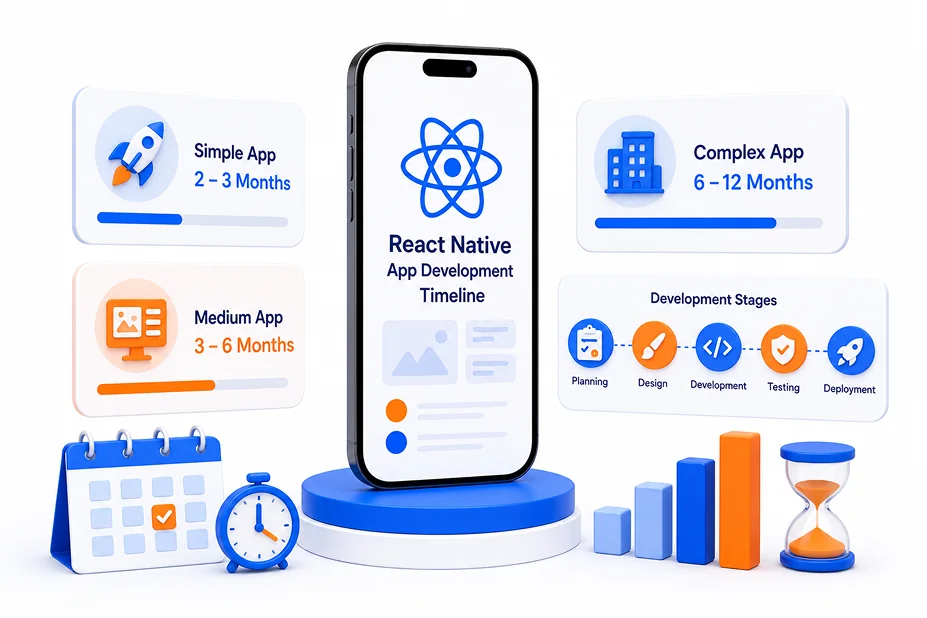
The time required to build a React Native app depends on its complexity, number of features, design requirements, and development team. A simple app may take around 2–3 months, while a medium-complexity app can take 3–6 months. Complex and enterprise-level applications may take 6–12 months or longer.
Each project goes through several stages, from initial planning and design to development, testing, and deployment. The timeline for each stage changes as the app becomes more complex.
| Development Phase | Basic App/MVP | Mid-Complexity App | Complex/Enterprise App | Key Activities |
|---|---|---|---|---|
| Discovery & Planning | 1–2 weeks | 2–3 weeks | 4–6 weeks | Requirements, feature planning, user flows, technical planning, architecture |
| Wireframing & UI/UX Design | 1–2 weeks | 3–5 weeks | 6–10 weeks | Wireframes, prototypes, visual design, design system, user journeys |
| React Native Development | 4–8 weeks | 12–20 weeks | 24–40+ weeks | Frontend development, navigation, core features, integrations |
| Backend & API Development | 2–4 weeks | 6–12 weeks | 12–24+ weeks | Database, APIs, authentication, business logic, admin panel |
| QA & Testing | 1–2 weeks | 3–5 weeks | 6–10 weeks | Device testing, bug fixing, performance, security, regression testing |
| Deployment | 1 week | 1–2 weeks | 2–3 weeks | App Store and Google Play preparation, submission, infrastructure setup |
| Estimated Total Timeline | 7–14 weeks | 4–8 months | 9–18 months | – |
Note:
Backend development can run alongside React Native development, so its duration does not always add directly to the overall project timeline.
What Can Delay a React Native App Launch?
The estimated timeline can change when the project scope expands or unexpected dependencies arise. Common factors include:
Changing requirements after development begins
Delayed design approvals or content
Third-party API and backend dependencies
Platform-specific functionality
Security and compliance requirements
Device compatibility issues
App Store or Google Play review delays
Late-stage QA and testing findings
Defining core features, scope, and requirements before development begins helps the team plan each phase more accurately, minimize uncertainty, and reduce costly delays or rework.
How Does Team Structure and Location Impact React Native Development Costs?
The development team you choose can significantly impact your overall React Native app development cost. Two teams may build a similar app but quote very different prices based on their location, experience, team structure, and engagement model.
For US-based projects, understanding these factors can help you balance development quality, project control, and budget.
React Native Developer Hourly Rates
Developer rates vary significantly by location and experience. US-based developers generally charge more than teams in regions such as India, Eastern Europe, and Latin America. Senior developers also command higher rates because they bring greater experience in architecture, performance optimisation, security, and complex integrations.
Here are typical React Native developer hourly rates by region:
| Region | Typical Hourly Rate |
|---|---|
| North America | $60–$180/hr |
| Western Europe | $50–$160/hr |
| Eastern Europe | $30–$95/hr |
| Latin America | $25–$85/hr |
| India | $15–$70/hr |
| Southeast Asia | $20–$80/hr |
These are broad market estimates. Actual rates can vary based on developer experience, project complexity, technical expertise, and whether you hire an individual developer or an agency.
Development Team Structure
A React Native project rarely involves just one developer. The size and roles of your team should match the scope of your application. A typical team may include:
Project Manager: Coordinates the project, timelines, communication, and deliverables.
React Native Developer: Builds the mobile application and implements its core functionality.
UI/UX Designer: Creates interfaces, user flows, wireframes, and visual design.
Backend Developer: Handles APIs, databases, authentication, and server-side functionality.
QA Engineer: Tests the app across devices and identifies bugs and performance issues.
DevOps or Cloud Specialist: Helps with deployment, infrastructure, CI/CD, and scalability when required.
A simple MVP may need a smaller team, while a complex fintech, healthcare, or enterprise application may require specialists across several areas. A larger team can increase the initial cost, but having the right expertise can also reduce delays and rework.
Engagement Models
How you hire and pay your development team also affects your budget. The three common engagement models are fixed-price, time-and-materials, and dedicated team.
| Engagement Model | How It Works | Best For |
|---|---|---|
| Fixed Price | You agree on the project scope and price before development begins. | Well-defined MVPs and projects with stable requirements |
| Time & Materials | You pay based on the hours or resources used during development. | Projects where requirements may evolve |
| Dedicated Team | A dedicated group works exclusively on your product for an agreed period. | Long-term products, SaaS platforms, and ongoing development |
| Vibe Code to Production Care Plan | You build your MVP with AI tools. Our team reviews the code, validates functionality and design, strengthens the infrastructure, and fixes critical issues before launch. | Budget-conscious startups that want to launch an AI-built MVP with greater reliability and confidence |
A fixed-price model offers greater budget predictability, but changes to the agreed scope may require additional charges. Time and materials provide more flexibility, while a dedicated team works well for long-term products and continuous development.
The vibe code to production care plan is a practical option for startups that have already built an MVP with AI tools and need expert support to make it production-ready.
Ultimately, the lowest hourly rate does not always mean the lowest project cost. The right engagement model should match your budget, project stage, and level of support you need to launch with confidence.

Need React Native Expertise Without the Guesswork?
Whether you're starting a new product or extending an existing engineering team, NebulaTech can help you evaluate the technical requirements, structure the right team, and build your React Native application with a clear path from planning to launch.
Connect With React Native Experts at NebulaTech
There is no universal price for a React Native application. A realistic budget depends on what you're building, who you're building it for, the technical complexity behind the product, and how much you need to support after launch.
At NebulaTech, we don't start with a developer count or an arbitrary hourly rate. We start by understanding the product.
Our consulting-first approach looks at your business goals, user journeys, feature priorities, technical architecture, integrations, security requirements, platform needs, and long-term roadmap before we recommend an implementation approach.
From there, our React Native engineers can help with product discovery, architecture, development, QA, deployment, and ongoing product improvements.
The goal isn't simply to build an app within a budget. It's to make sure the budget is being invested in the right product decisions.
If you want to keep development costs competitive without compromising on expertise, NebulaTech is the partner you need. Our Hybrid App Development team helps you plan, build, test, and scale your app with a development approach tailored to your requirements and budget.
FAQs on React Native App Development Cost
Yes. React Native remains an actively developed cross-platform framework in 2026-27, with ongoing improvements to tooling, JavaScript/TypeScript APIs, platform integration, and developer experience. React Native 0.87, released in August 2026, introduced several updates, including the Strict TypeScript API as the default JavaScript API.