



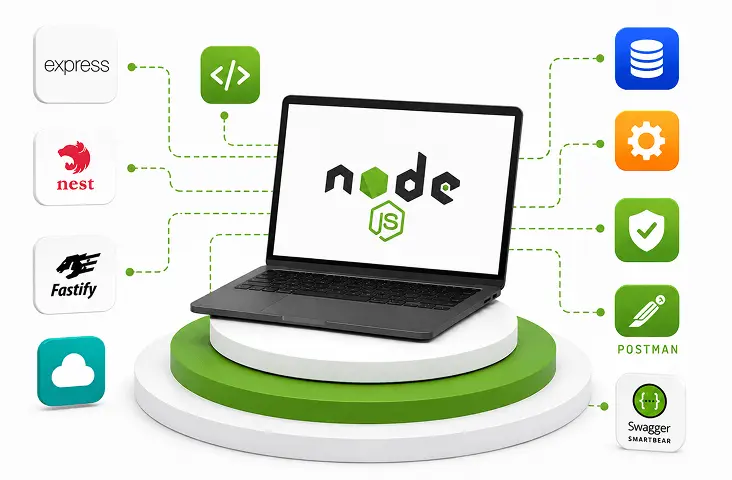



Hire Node.js Developers

Event-driven architecture, High-concurrency performance.

Node.js icon

Built for scale from day one.

verified

NDA Protected from Day One

verified

Shortlisted Engineers in 24-48 Hours

verified

Full IP Ownership - Always

verified

NDA Protected from Day One

verified

Shortlisted Engineers in 24-48 Hours

verified

Full IP Ownership - Always

Node.js
Engineered for speed and scalability.

API Gateway

API Gateway

Real-Time APIs

Real-Time APIs

WebSockets

WebSockets

Microservices

Microservices

Start within

48

hours

When your product depends on high-concurrency APIs, real-time data delivery, or microservices that stay fast under load, your backend engineering decides how well your system scales - and how confidently it gets there.

Hire Node.js developers through NebulaTech and you get backend specialists - not generalists - who build event-driven systems designed to perform when it matters. You can have shortlisted candidates ready within 24–48 hours.

We evaluate your backend architecture requirements before matching any engineer. Clear engagement structure. Precisely matched engineers. Just a structured process that gets your systems built right.

AI chip

Engineers who understand concurrency models, async data flows, and how AI-assisted tooling can accelerate delivery without inflating team size.

Why NebulaTech Is a Trusted
Node.js Development Partner

Hiring a backend engineer is one thing. Finding someone who understands Node.js at the architectural level - event loop behaviour, non-blocking I/O patterns, how clustering affects concurrency under real production load - is a different challenge. That difference is where NebulaTech adds measurable value.

Consulting-Led Hiring, Not Staffing

Consulting-Led Hiring, Not Staffing

We operate as a consulting-led partner, not a recruiter. Before shortlisting a single engineer, we review your backend requirements: what the system handles, what scale you're planning for, and which architectural decisions will affect you twelve months from now. That review shapes which engineers we put in front of you - and how the engagement is structured.

Industry-Relevant Backend Experience

Industry-Relevant Backend Experience

Our Node.js backend developers have delivered production systems across fintech, SaaS, healthcare, and e-commerce - environments where API reliability and system throughput carry real business consequences. They bring architecture awareness alongside framework knowledge, which is the combination that prevents expensive rewrites later.

Production-Grade Backend Delivery Track Record

Production-Grade Backend Delivery Track Record

Our Node.js engineers have shipped backend systems handling real concurrency loads - from greenfield API builds and microservices decomposition to integrating Node.js services into existing enterprise architectures. The same technical rigour applies whether the brief is a new build, a scale-out, or a modernisation of legacy backend systems. Coverage spans service design through production deployment, including support for teams running Node.js development for New York-based operations.

Timezone-Aligned Collaboration

Timezone-Aligned Collaboration

Work seamlessly across US, UK, EU, and APAC time zones with structured overlap and real-time coordination built into the engagement.

Multilingual & Communication-Trained Engineers

Multilingual & Communication-Trained Engineers

Our Node.js developers are trained in sprint communication, documentation clarity, and stakeholder alignment - ensuring smooth collaboration across distributed teams.

Rocket

The next step is understanding where structured backend engineering makes the most impact.

What Our Node.js Developers Can Offer

Hire Node.js developers through NebulaTech to access end-to-end backend services built around your product's technical reality - not a fixed package. From custom application development and microservices decomposition to API engineering, real-time systems, and serverless architectures, our engineers deliver scalable, production-ready backend solutions designed for long-term system health.

Custom Node.js Application Development

Build scalable, high-performance backend applications tailored to complex business requirements. Hire Node.js developers to leverage the runtime's event-driven, non-blocking I/O architecture for lightweight, efficient, and enterprise-grade systems.

Real-Time Application Development

Implement real-time features such as WebSockets, Socket.IO, and server-sent events. Whether the use case is live chat, video streaming, collaborative tools, or live dashboards, hire Node.js developers to build event-based systems optimised for fast data streaming and low-latency operations.

Node.js Microservices Architecture

Architect microservices that decouple monolithic applications into modular, independently deployable services. Our engineers optimise inter-service communication using Kafka, RabbitMQ, or gRPC for better scalability, fault tolerance, and clean service boundaries.

API Development and Integration

Design RESTful and GraphQL APIs with advanced functionality, versioning, and security built in. Hire Node.js developers to build scalable APIs using Express.js, Fastify, or NestJS - with seamless integration across databases, microservices, and third-party platforms. See also: Backend architecture and API development

Serverless Application Development

Build cloud-ready serverless backends using AWS Lambda, Azure Functions, or Google Cloud Functions. Our developers design serverless architectures for rapid deployment, minimal infrastructure overhead, and elastic scalability under variable traffic.

Node.js Consulting Services

Get in-depth technical analysis and architectural guidance for your Node.js initiative. Our consultants evaluate your use case, recommend advanced design patterns, improve system scalability, and optimise backend architecture for high-demand environments - before code commitments are made.

Node.js Maintenance and Support

Maintain backend reliability with continuous monitoring, performance optimisation, and version upgrades. Hire Node.js developers to debug complex runtime issues, apply security patches, manage dependency updates, and keep frameworks and libraries aligned with current LTS standards.

The right service mix depends on where your product is today and what your backend needs to handle next.

Why Hire Node.js Developers - And When It's the Right Call

Node.js isn't the answer for every backend problem. It's the right answer when your system handles high volumes of concurrent connections, depends on real-time data delivery, or runs I/O-bound workloads where non-blocking architecture is an advantage, not a preference.

Scenarios where hiring dedicated Node.js developers makes strategic sense:

 High-Concurrency API Demands

High-Concurrency API Demands

You're building APIs or microservices that need to handle thousands of concurrent requests without degrading response times.

Real-Time Product Requirements

Real-Time Product Requirements

Your product requires real-time features - live notifications, collaborative tools, event streaming - where persistent connections matter.

Microservices & Backend Modernization

Microservices & Backend Modernization

You're moving from a monolithic backend to distributed services and need engineers who understand service boundaries and inter-service communication.

Need for Scalable Backend Expertise

Need for Scalable Backend Expertise

Your existing team lacks the depth to design a backend that scales beyond current traffic - and the learning curve would delay your roadmap.

Dedicated Node.js Capacity Without Hiring Overhead

Dedicated Node.js Capacity Without Hiring Overhead

You need a dedicated Node.js development team without the overhead of permanent headcount additions.

Signs it's time to bring in specialists rather than train existing staff:

Backend Performance Bottlenecks

Backend Performance Bottlenecks

Backend performance is already a bottleneck and the codebase reflects ad hoc growth rather than planned architecture.

Scaling Beyond a Monolithic Backend

Scaling Beyond a Monolithic Backend

Your product is expanding from web to distributed services and the backend needs structural changes, not feature additions.

Long-Term Architecture Decisions

Long-Term Architecture Decisions

A new build is being planned and architectural decisions made now will determine what the system costs to operate three years from now.

Rocket

Once dedicated hiring becomes the right approach, the next question is what you actually gain from the right team.

Quick Overview - What You Get When You Hire Node.js Developers From Us

Developer working at a professional office setup

Shortlisted engineers within 24-48 hours - pre-vetted, matched, ready to interview.

Backend systems built for concurrency and I/O performance - not just framework familiarity.

Consulting evaluation before any engineer is placed - architecture reviewed first.

Flexible engagement - adjust team size based on delivery needs without resetting the engagement structure.

Full IP ownership and NDA protection - standard on every engagement, not optional.

AI-assisted development where it reduces delivery time - API scaffolding, repeated data patterns, performance profiling.

AI-Augmented Backend Engineering & Intelligent System Capabilities

We apply AI in two practical ways - both focused on improving delivery outcomes, not adding complexity.

AI-Assisted Workflows

AI-Augmented Engineering Workflows

Our engineers use Claude AI, GitHub Copilot, and Cursor to compress repetitive backend work - scaffolding REST and GraphQL endpoints, generating boilerplate for async/await chains and middleware, and surfacing likely root causes when debugging event-loop blocks or slow I/O paths.

The goal is to reduce repetitive work while engineers focus on architecture, concurrency, and performance decisions.

AI-Powered Features

AI-Powered Backend Capabilities

Where your product roadmap includes AI features - intelligent routing, recommendation engines, classification pipelines, semantic search - we evaluate integration feasibility and build them into the Node.js architecture as first-class services rather than retrofits.

Each implementation is judged on real product value, not novelty.

How you engage the team is just as important as who you hire.

Free Node.js Backend Performance Audit

Get a structured evaluation of your backend system - covering concurrency handling, API efficiency, and scalability readiness.

No obligation. No commitment. Just clarity on where your system stands.

Hiring Models - Choose What Fits Your Backend Stage

Different backend projects require different structures. A system in active development with an evolving roadmap needs sustained engineering continuity. A clearly scoped API rebuild needs a defined delivery timeline. We offer three hiring models aligned to those realities.

Full-Time Hiring

A full-time Node.js developer works as an integrated part of your team, ensuring continuity, deep system understanding, and consistent delivery velocity. A dedicated node js developer in this model retains full product context across sprints, which eliminates the onboarding tax of repeatedly bringing new engineers up to speed.

Best For: Long-term backend development and evolving systems.

Part-Time Hiring

Provides flexible engineering capacity without full-time commitment. Engineers operate on a defined weekly bandwidth, slotting into your sprint rhythm with the same accountability and communication structure as a full-time hire.

Best For: Ongoing improvements, support, or incremental backend work.

Fixed Monthly Support

Ensures steady progress with controlled budgets and timelines. A predictable monthly engagement covering performance profiling, dependency management, and incremental feature work - cost is fixed, scope is defined, and SLAs are clear.

Best For: Clearly defined backend scopes with predictable delivery cycles.

Once the engagement model is clear, the next concern is how teams communicate and stay aligned across time zones.

Team Structure and Communication - How We Keep Delivery on Track

Clear communication and coordination are critical in distributed backend teams - which is why we structure delivery this way:

How the delivery team is organised:

Node.js Developer(s)

accountable for backend architecture decisions, code quality, and daily output.

QA Engineer

integrated into the sprint process, validating performance and reliability alongside feature delivery.

Project Manager

coordinates priorities, surfaces scope changes, and maintains alignment between delivery and product requirements.

Client

retains full visibility and direct access throughout the engagement, not managed through an account layer.

Communication tools and rhythm:

Daily standups via your preferred platform - Slack, Teams, or equivalent.

Weekly progress reports with delivery metrics and upcoming priorities.

Collaborative project management via Jira, Linear, or similar tools.

Timezone overlap engineered into engagement planning from the start.

Architecture decisions are documented. Sprint reviews are structured. Scope changes are managed deliberately, not absorbed silently into the backlog.

Beyond communication, technical depth is what determines whether the backend stays healthy long-term.

Node.js Ecosystem & Technology Stack

Our developers work across the full Node.js ecosystem - from core backend development and architecture to integrations, scalability, and performance optimisation.

Core Platform

Node.js (LTS)Express.jsNestJSFastify

Language / Logic Layer

JavaScript (ES6+)TypeScriptasync/await patternsworker threadsevent emitters

Data / Integration

PostgreSQLRedisREST APIsGraphQLWebSocket / Socket.IOmessage queues (RabbitMQ, Kafka)

Cloud & Infrastructure

AWSAzureGoogle CloudDockerKubernetesCI/CD pipelines (GitHub Actions, GitLab CI)

Advanced Capabilities

Microservices ArchitectureEvent-driven SystemsReal-time ProcessingPerformance ProfilingHorizontal ScalingObservability (Logging, Monitoring, Tracing)

With the technology foundation in place, the next step is understanding how quickly the engagement can start.

Our Hiring Process - From Brief to Active Development

Start with qualified Node.js developers in as little as 48 hours. The process is structured to remove the factors that typically slow backend developer hiring: ambiguous briefs, mismatched shortlists, and onboarding gaps that cost two weeks before the first production commit.

01

Developer Shortlisting

We identify and shortlist the best Node.js engineers for your needs.

24-48 hours

02

Technical Interview

You interview shortlisted candidates (technical + cultural fit).

1-2 days

03

Onboarding & NDA Signing

NDA signing and onboarding are handled in parallel, not sequentially.

2-3 days

04

Active Development Start

Development begins immediately upon onboarding completion.

Immediate upon Onboarding

How the process works in practice:

You submit your requirements - technical needs, team structure, timeline, and backend context.

We shortlist Node.js engineers from our vetted pool, matched against your specifications.

You interview shortlisted candidates (technical + working style fit).

NDA signing and onboarding are handled in parallel, not sequentially.

Development begins immediately upon onboarding completion.

This structured process ensures both speed and precision in getting the right backend engineer into your team.

Comparing Your Hiring Options - Freelancer, Agency, and Dedicated

The hiring model you choose shapes delivery speed, code ownership, and the reliability of your backend team. Understanding what each approach actually delivers helps you choose the one that fits your product stage, risk tolerance, and backend requirements.

For most product teams building scalable backend systems, the dedicated model provides the best balance of engineering continuity, cost efficiency, and long-term system quality.

Freelancer vs Agency vs Dedicated Node.js Team

Criteria

  • Cost Predictability
  • Team Continuity
  • Communication
  • Scalability
  • Code Ownership
  • Risk Level

Freelancer

  • Low
  • Risk of churn
  • Direct but limited
  • Add freelancers ad hoc
  • Negotiable
  • Higher

Agency

  • Medium
  • Resource Rotation
  • Account manager layer
  • Agency Capacity Limits
  • Varies
  • Medium

Dedicated Team

  • High-fixed monthly
  • Consistent team
  • Direct daily access
  • Scale up/down easily
  • 100% client-owned
  • Lower

Swipe to compare

Offshore Dedicated vs In-House Node.js Development

In-House

  • Hiring Time
    6-12 weeks
  • Cost Structure
    Salary + benefits + overhead
  • Talent Pool
    Limited to local market
  • Flexibility
    Fixed team size
  • Knowledge Retention
    High (If staff stays)
  • IP Protections
    Standard employment law
VS comparison marker

Offshore Dedicated

  • Hiring Time
    24-48 hours
  • Cost Structure
    Engagement-based, no overhead
  • Talent Pool
    Access to global specialists
  • Flexibility
    Scale as needed
  • Knowledge Retention
    High dedicated assignment
  • IP Protections
    NDA + full IP ownership

Hiring Speed Comparison

In-House

Job Post
6-12 Weeks
Start

Offshore Dedicated

Brief
24-48 hours
Active Development

The offshore dedicated model consistently outperforms the alternatives on speed, flexibility, and total backend delivery cost - particularly for systems where Node.js's performance advantages are already built into the architecture.

Understanding these differences makes it easier to select the model that fits your current product stage.

Who Hires Node.js Developers - And Why

The reasons for bringing in dedicated Node.js backend developers vary significantly by organisation type. Here's how different teams typically approach it.

Startups

For early-stage products, backend architecture decisions made now determine what the system costs to scale later. Startups hire dedicated Node.js engineers to get production-grade backend infrastructure without carrying senior engineering headcount permanently on the payroll. The ability to bring in specialists on a flexible basis - scaling the team as the product evolves - is a significant advantage when runway matters.

Product Teams at Mid-Market Businesses

Teams that have validated their product and are hitting performance or scalability ceilings bring in Node.js specialists to address architectural constraints without pulling internal engineers off product work. This typically involves microservices decomposition, API layer redesign, or real-time feature integration that requires backend depth the existing team doesn't carry.

Enterprises

Enterprise teams hire Node.js developers for three common reasons: modernising legacy backend systems that can't handle current traffic patterns, building internal operational tools that need API-level performance, or extending existing platforms into distributed architectures. The consulting-led engagement model is relevant here - large organisations benefit from architectural evaluation before committing development resources to a new backend direction. For enterprises managing complex software programmes, Node.js often serves as the performance-critical integration layer between core systems.

Digital Agencies

Agencies bring in contract Node.js developers to expand backend delivery capacity without adding permanent engineering headcount. This allows agencies to take on backend-intensive client projects - real-time platforms, API-first builds - without maintaining a full-time backend practice internally.

These scenarios reflect how different teams benefit from structured Node.js hiring.

What Makes - NebulaTech Different

There's no shortage of Node.js engineers available for hire. What determines whether the engagement actually delivers what your backend needs is the evaluation process, the architectural discipline, and the risk controls around it.

Consulting-first approach to Node.js development

Consulting-First Approach

We don't start by sending CVs. We start by understanding your backend system - what it handles today, what it needs to handle next year, and what architectural decisions will create problems if they're made wrong now. That evaluation shapes which engineers we shortlist and how the engagement is structured before any code is written.


Architecture-led Node.js execution

Architecture-Led Execution

Our Node.js backend developers are accountable for technical decisions, not just task completion. Architecture documentation, service boundary definitions, and data layer design are treated as deliverables - not optional extras. That accountability extends past the initial build, because the decisions made early determine what the system costs to maintain and extend over time.

Risk reduction by design

Risk Reduction by Design

NDA protection is standard, not negotiated. Full IP ownership belongs to the client without ambiguity. Every engagement is covered by a clear contract specifying deliverables, milestones, and how scope changes are handled - so there are no surprises at the billing stage.

Practical AI usage in Node.js development

Practical AI Usage

Where AI tooling improves development throughput on repetitive backend tasks - API scaffolding, data structure handling, common debugging patterns - we apply it. Where your product roadmap includes AI-driven features, we evaluate integration feasibility. No capabilities added because they're trending.

Explore Related Resources

For broader context on backend development strategy and hiring options, these pages provide additional information:

Frequently Asked Questions

You can typically have shortlisted engineers ready to interview within 24–48 hours. Onboarding - including NDA signing and development environment setup - completes within 2–3 days, and development begins immediately after. This timeline is possible because we maintain a vetted pool of Node.js backend developers rather than sourcing from scratch against every brief.

Hire Node.js Developers -
Start Within 48 Hours

Scalable backend infrastructure is built on the right architectural decisions from the start. It requires architectural decisions made with real production constraints in mind, engineers who understand Node.js at the system level - not just the framework level - and an engagement model that matches where your product actually is today.

Whether you need a single Node.js backend developer to integrate with your existing team, a dedicated squad to own full backend delivery, or a consulting engagement to evaluate your technical direction before committing - we can structure the right approach for your requirements.